
 Click to Zoom +
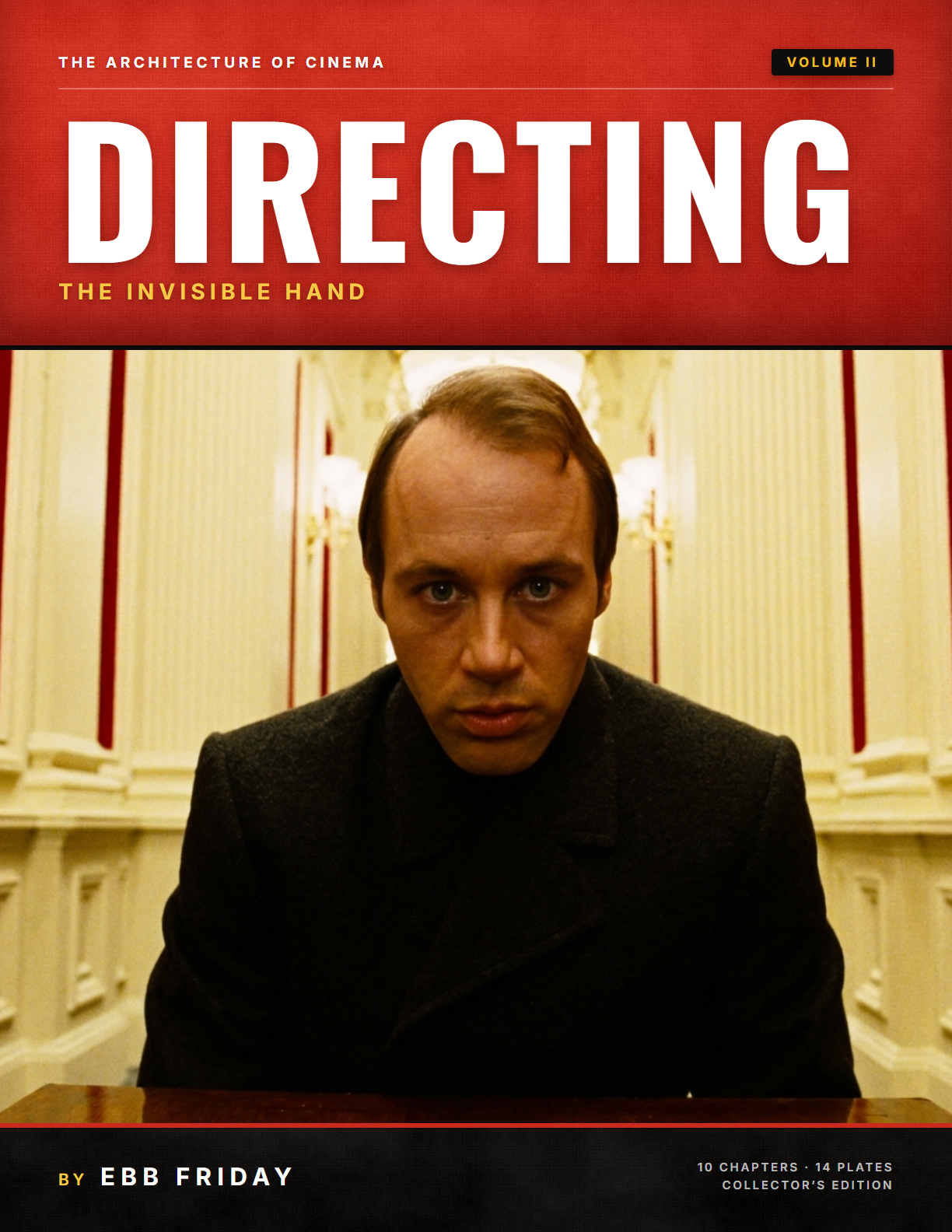
Directing
The Invisible Hand
Directing is not shouting action—it is deciding where the audience’s heart stands inside the room. Master subtext, geometric power-blocking without cuts, progressive lens plots, working with actors through playable action verbs and living eyes, Hitchcockian suspense, and commanding a modern set from rehearsal through the final cut.
Instant high-resolution 8.5″ × 11″ Digital Collector’s PDF delivered immediately after checkout.
- 10 Deep-Craft Directing Chapters
- 14 Full-Bleed Widescreen Plates
- 6 Architectural Directing Blueprints
- 28-Film Master Study Canon
- On-Set Pocket Command Card
- Instant iPad, Desktop & Print PDF
Pretty shots get forgotten.
Invisible directing stops the room.
Built like a collector’s museum monograph and written like a working Hollywood director’s private playbook.
Direct Actors Without Result Direction
Banish lifeless adjective notes forever. Unlock genuine, vulnerable performances using transitive action verbs, moment-by-moment listening, emotional events, and private one-note adjustments.
Architectural Blueprints You Can Stage From
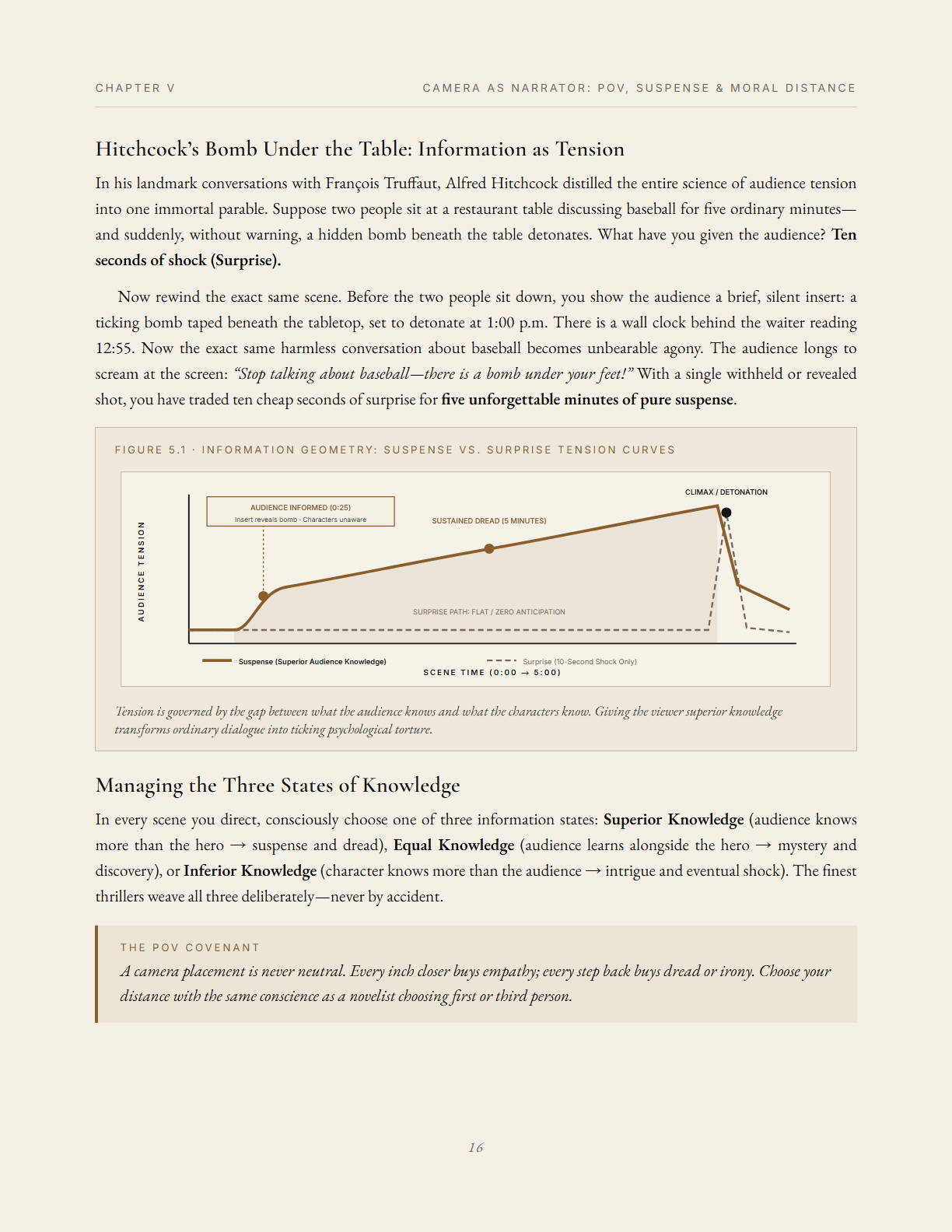
Six drafting-grade diagrams: Kurosawa power-triangle reversals, Lumet’s progressive 3-act Lens Plot, Hitchcock’s Suspense vs. Surprise curves, vertical class elevations, and 180° axis crossings.
Grounded in Cinema’s Greatest Auteurs
Deconstructs Akira Kurosawa, Sidney Lumet, Alfred Hitchcock, Stanley Kubrick, Bong Joon-ho, Martin Scorsese, David Fincher, Steven Spielberg, Christopher Nolan, and Denis Villeneuve.
Click any spread to inspect the craft up close.
Full-width widescreen cinema plates, precision blocking diagrams, and battle-tested set discipline.
 Zoom +
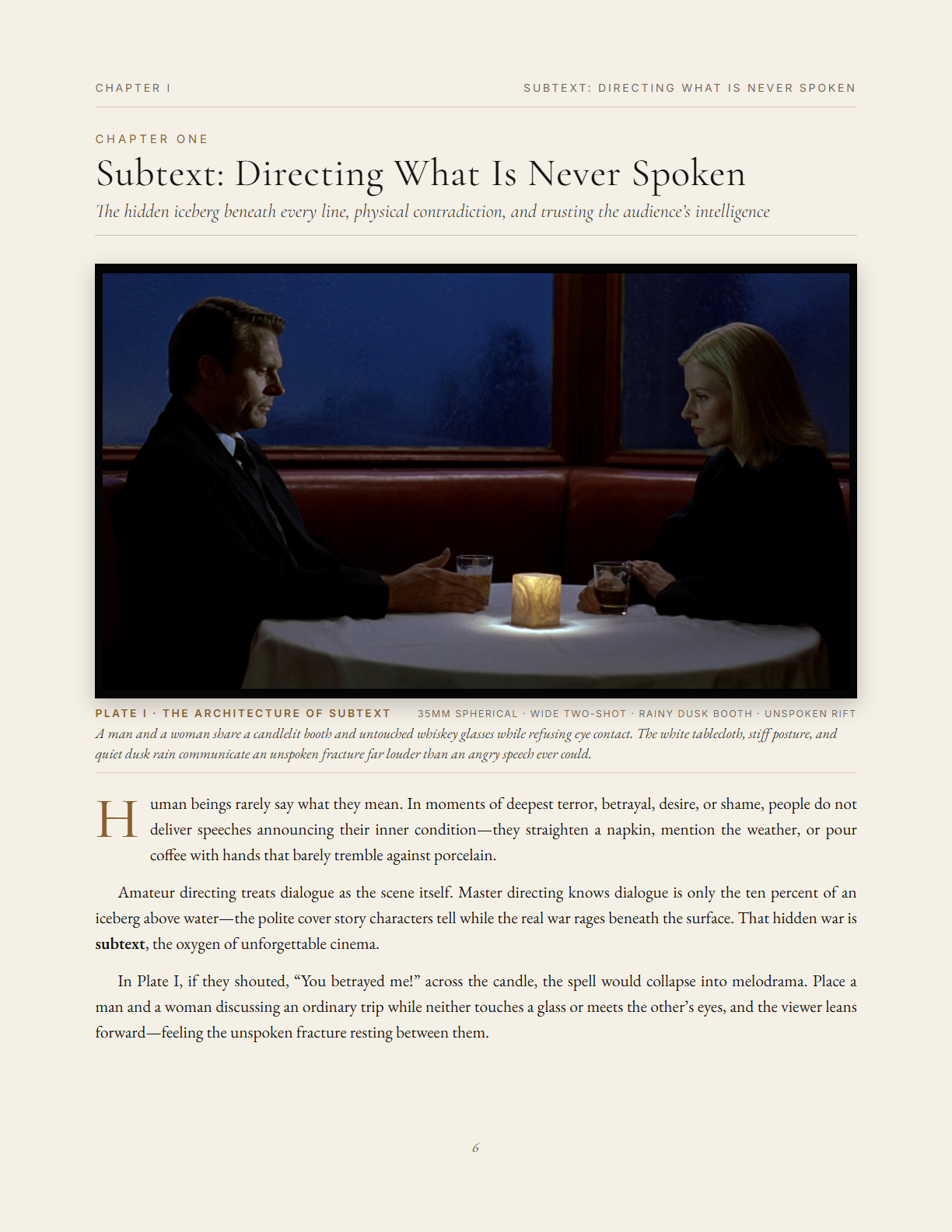
Directing What Is Never Spoken
Turn on-the-nose exposition into silent physical contradiction—mastering the iceberg beneath every line and the Rule of Two-Plus-Two.
 Zoom +
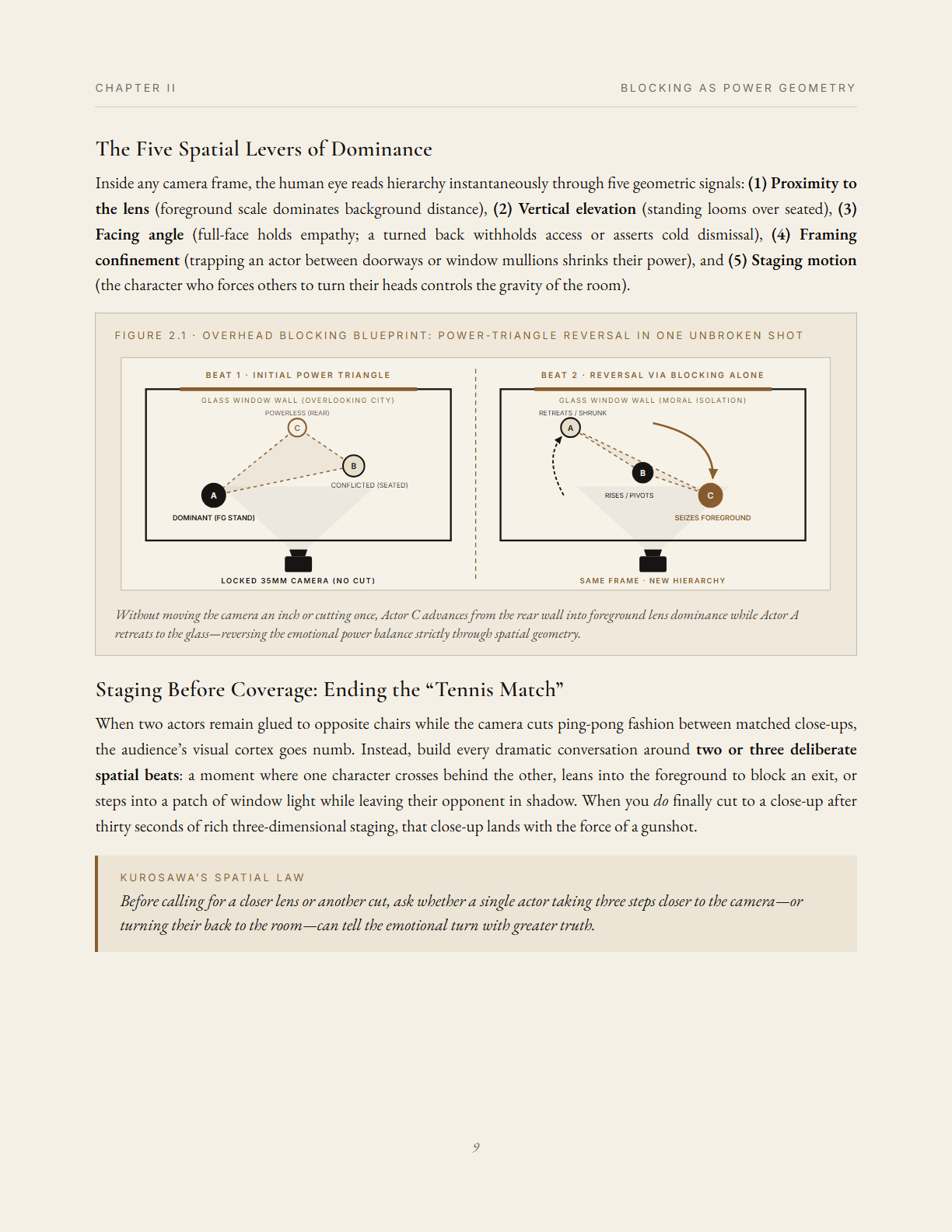
Blocking as Power Geometry
End flat “tennis-match” coverage: reverse emotional dominance inside a single unbroken frame using Kurosawa’s five spatial levers.
 Zoom +
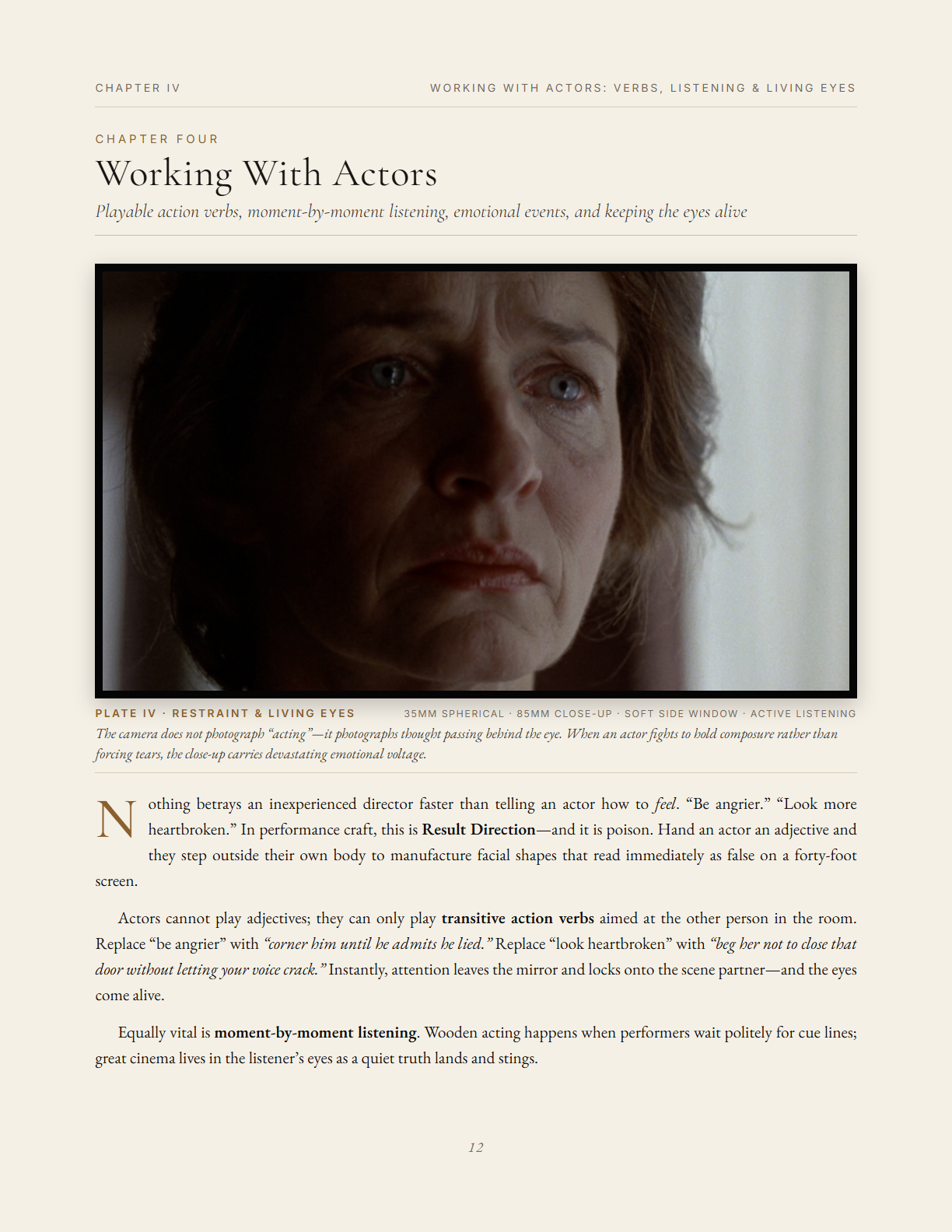
Verbs, Listening & Living Eyes
Replace toxic result direction with concrete transitive verbs, protect Beat One innocence, and compare Scorsese, Fincher, Nolan, and Villeneuve.
 Zoom +
POV, Moral Distance & Suspense
Choose subjective proximity vs. voyeuristic detachment deliberately, and engineer five minutes of Hitchcockian dread over ten seconds of shock.
Ten chapters of working directorial craft.
Every law of blocking, performance, suspense, and set leadership—engineered for real productions.
Prologue: The Invisible Hand & Prep
Guarding the spine of the story, Sidney Lumet’s floor-taped rehearsals, and the 9-Step Pre-Production Directing Protocol.
Subtext: What Is Never Spoken
The iceberg beneath dialogue, text-against-behavior contradiction, and the Rule of Two-Plus-Two.
Blocking as Power Geometry
Akira Kurosawa’s deep staging without cuts, the five levers of dominance, and Power-Triangle Reversal (Figure 2.1).
The Lens Plot & Compression
Sidney Lumet’s progressive 3-act focal and eye-height curve (Figure 3.1) to tighten a room’s psychology invisibly.
Working With Actors & Living Eyes
Playable action verbs vs. result direction, active listening, Scene Events, and the 4-Director Temperament Matrix.
Camera as Narrator & Suspense
Subjective POV vs. Fincher’s velocity-locked objectivity, plus Hitchcock’s Suspense vs. Surprise curve (Figure 5.1).
Monumental Scale & Silence
Denis Villeneuve’s dialogue restraint, Stanley Kubrick’s one-point symmetry trap, and holding three beats longer.
Visual Motifs & Vertical Hierarchy
Bong Joon-ho’s vertical class architecture (Figure 7.1), dividing-line framing, and the Plant–Echo–Transform rhythm.
Action, Tension & the Unbroken Oner
Spatial geography under chaos (Mann / Miller) and multi-plane single-take choreography (Spielberg / Scorsese / Cuarón).
Shot Listing & Set Command
Three surgical setups over eighteen wasteful angles, intentional 180° axis crossings (Figure 9.1), and leading crews calmly.
Sound, Rhythm & the Cut Bay
Directing off-screen sound, acoustic pre-laps, surrendering ego to your editor, and The Three Rewrites (Figure 10.1).
Afterword, Command Card & 28-Film Canon
The 30-Day Blueprint Study, 4-Quadrant On-Set Pocket Command Card, and 28 landmark films (1957–2025).
Collect all five pillars of cinema.
Cinematography
Light & Shadow
Shadow psychology, day & night set craft, optics, exposure, grip & emulsion.
Directing
The Invisible Hand
Subtext, power-blocking, lens plots, playable verbs, suspense & set command.
Set Design
Architecture as Character
Brutalist scale, practical-first world-building, patina & Color Scripts.
Editing
Sculpting Time
The Rule of Six, musical rhythm, sound-first pacing & invisible cuts.
Color Grading
Soul of the Emulsion
Scene-referred pipelines, characteristic curves, density & DI finishing.
Direct every scene with quiet mastery—starting today for $19.99.
Instant download of the full 32-page high-resolution Collector’s PDF (8.5″ × 11″). Lock in the $19.99 launch price before it returns to $39.99.
How do I get the book?
Immediately after checkout you receive a secure instant-download link for the full 32-page high-resolution PDF—ready for iPad, laptop, phone, or local printing.
Who is this written for?
Directors, screenwriters, cinematographers, producers, and ambitious filmmakers ready to master blocking, subtext, performance, and calm set leadership.
Do I need Volume I first?
Each monograph stands completely on its own—and pairs seamlessly with Volume I (Cinematography) to give you total command of both performance and image.